Category Archives: Uncategorized

Japan, Britain to sign cross-servicing pact

uk-japan[ekm]300x155[ekm]

Leave a comment

April 30, 2014 · 5:15 pm

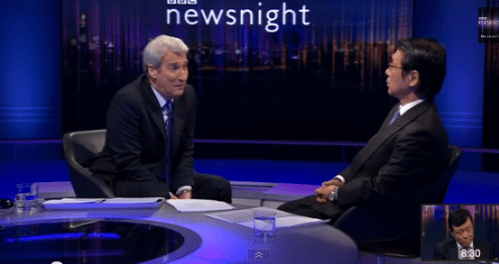
WW2 torpedoman Danny Rackman and Yuichiro Nakajima, son of a kamikaze pilot discuss on BBC Newsnight

Just  the kind of open, civil discussion that ‘squarely faces the trajedy of war‘ between the UK and Japan, making the ‘new type of alliance‘ possible.

Why can such a discussion happen in London, but not in Seoul or Beijing?

Leave a comment

Filed under Uncategorized

Monday morning quarterbacking the BBC interview

Ambassador Hayashi and Jeremy 'Paxo' Paxman

Ambassador Hayashi and Jeremy ‘Paxo’ Paxman

I sometimes suffer from a painful condition. Shortly after an argument I always think of the words I should have said. But it is too late. I promise myself to use them for next time. I have no idea if Ambassador Keiichi Hayashi also has moments like that.

Paxo: Ambassador, these islands aren’t inhabited, why not just give them to the Chinese?

林 景一: Imagine if the Falklands had not been inhabited. Would Prime Minister Thatcher have given them to General Galtieri in 1982? Why not? Would that have been right? I think not.

Paxo: But is it really worth jeopardizing the security of that whole part of the world and possibly the world itself?

林 景一: It is not, and so that is certainly a question you should ask China. We have a system of international order. We have age old principles of self defence and sovereignty that everyone has to respect. We are defending this order in the face of aggression from China, so please ask them this question.

Paxo: Isn’t what is really happening here is that Japan is seeking to re-establish a military identity?

林 景一: No. In fact despite rising threats from North Korea and China, Japan is still holding firmly to its identity as a peaceful democratic nation. We are fortunate to have like-minded friends and allies like the United States and Britain to help us defend these principles. We left our military identity behind after WWII and placed our security in the trust of the principles of the United Nations. Japan learned the hard way that a military identity, a totalitarian political order, and a militaristic foreign policy courts national disaster. We will never repeat this mistake. But  we will also work to warn other nations not to make this mistake, because that that way lies disaster.

Paxo: It’s true you are seeking constitutional reform, though?

林 景一: There is a debate in Japan about our constitution, you are right. Our system is a parliamentary democracy, just like here, because it was modeled on the Westminster system. So ideas will be proposed, openly debated and decided by the representatives of the will of the people. And I can assure you that the Japanese people remain as opposed to a military identity for their country now as they have been for the past half century or more. Sorry but if I may add, your question changes the subject. The debate in Japan on the Constitution is focused mainly on whether we should include an amendment to explicitly allow for collective self-defence and acknowledge the existance of a military capability for defending the country. However, that would not change the situation with these islands, which is one where Japan is exercising the right of individual self-defence, which is basic to all nations. So if you don’t mind my saying so, this issue of amending the constitution may be a bit beside the point.

Paxo: Why does PM Abe want to remove the inhibition on settling disputes by force of arms?

林 景一: Settling disputes by force or arms is always – for all countries – a last resort. This is an accepted principle of just war going back centuries, but also of our UN Charter today. As I said just now, if Japan faces an armed attack, then we have the right, indeed the obligation to defend ourselves. Now on the Japanese Constitution, we remain as committed as ever to settling disputes by peaceful means – no-one in Japan is advocating anything different. But I am afraid I have to say that the question of constitutional reform really is un-connected to our problems with China over these islands. That is a straightforward matter of defending our national sovereignty against the threat of armed attack.

Paxo: Do you think it helps things by using childish abuse comparing people to Voldermort for example?

林 景一: I was responding to the metaphor suggested by the Chinese Ambassador, so you perhaps can ask him this question.

Paxo: But you say there is nothing to talk about. How can there be dialogue when you consider there is nothing to discuss?

林 景一: We are ready to sit down and talk any time. We have had a dialogue with China and with Korea and with Russia about such things for some time, so it is unfortunate that now China is refusing to discuss with our Prime Minister. Why does China refuse? The reason they are giving – our Prime Minister’s visit to a war memorial shrine – is very difficult to accept. During the Cold War, when we were both feeling threatened by the USSR, China never raised such objections. This makes people wonder if perhaps it is a kind of pretext. Prime Minister Abe is of course mindful of how the shrine has become a political and diplomatic issue. Which is why he made a point of explaining his motives on the occasion of hist latest visit: a profound recognition that Japan must never wage a war again. A conviction based on the severe remorse for the past. A renewed determination before the souls of the war dead to firmly uphold the pledge never to wage a war again.

Paxo: OK Ambassador. Thank you very much.

1 Comment

Filed under Uncategorized

Facing our war history: “Some time, the hating has to stop”

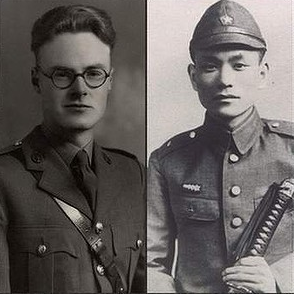
Eric Lomax and Nagase Takashi

Eric Lomax and Nagase Takashi

Japan’s Ambassador to the UK Keiichi Hayashi provided the byline for this blog – “a new type alliance”, in a speech he gave a few months ago. He said something else in that speech that I thought worth following up, and have only now had a chance:

“By mentioning the Anglo-Japanese Alliance, I am not seeking merely to dwell on past glories. Surely we had the tragedy of another war which we fought against each other and have always to squarely face

Memories of that past war are being turned into weapons in a new war of global public opinion. China’s Ambassador to Britain wrote a letter to the British newspaper the Telegraph on 1 January 2014, placing the international community on ‘high alert’ because PM Abe is attempting ‘the resurrection of Japanese militarism’. To illustrate his point on the danger of Japanese militarism, Ambassador Liu selected an unusual story to remind the British public about their own experience of war with Japan:

“Next week, The Railway Man, a film based on a true story, will be released. It tells the tragic story of a British PoW tortured by the Japanese in the Second World War. The film is not only about the atrocities committed by his Japanese captors, but also how one of them is harrowed by his own past. His redemption is only effected through deep remorse and penitence”.

That British PoW’s name was Eric Lomax, and he died not long ago during the filming of his story. Eric’s story became more widely known following his dramatic reconciliation with the Japanese soldier who tortured him in Thailand, Nagase Takashi. Through this reconciliation he said he ‘found some kind of peace and resolution‘. When Eric’s wife accompanied him back to the graves of British PoWs who died in the war,  she asked if reconciliation with Nagase might be some kind of betrayal. He did not see it that way, replying to her “Patti, some time the hating has to stop”. Finally Patti had those words written on her husband’s grave.

“Some time, the hating has to stop” is is a sentiment notably absent from China and Japan’s latest efforts at public diplomacy. I draw two conclusions from this: (1) This suggests the link China is making between Japan’s wartime aggression and the present disputes is most probably disingenuous, and therefore offensive to the memories of men like Eric Lomax; and (2) Japan is neglecting its history of reconciliation (stories like Takashi’s) as a source of soft power.

In his letter, China’s Ambassador Liu seemed only interested in one aspect of the Lomax/Takashi story, which was the aggression, then remorse and penitence of the Japanese soldier. The importance of forgiveness (by Lomax) perhaps not serving his purpose. Contrary to what seems like an attempt to inspire the British to see China’s side of the argument over Japanese militarism, Amb. Liu inadvertently highlighted the quintessential case of Anglo-Japanese post-war reconciliation.

It is a story, in all its aspects, that Amb. Hayashi would do well to consider, along with his commitment to ‘squarely face’ this history, especially in his response to Amb. Liu. Perhaps because he felt all this was merely a ruse, he chose instead to base his latest defence more on a legal argument. He may succeed in this, but Japan should not disregard the power of such stories to form public opinion and inform policy. Like Takashi Nagase, Japanese leaders have apologised so are present generations not ready to be forgiven? Since China has noted Eric Lomax’s story, can it learn a lesson from him as well?

Amb. Liu said in a BBC interview subsequent to his letter that the reason China cannot talk to Japan about its territorial disputes is because PM Abe visited Yasukuni shrine. A relationship between post-war remorse and contemporary power politics continues to be held against Japan. But Japan has a strong case on both counts, and if this link continues to be sustained the significance of successful Anglo-Japan reconciliation should not be overlooked.

Lomax and Takashi in later years.

Lomax and Takashi in later years.

3 Comments

Filed under Uncategorized

UK and China Ambassadors discuss history and sovereignty on BBC Newsnight

Leave a comment

January 9, 2014 · 9:24 am

China uses war memories to enlist UK in territorial dispute against Japan

China's Ambassador in London, liu Xiaoming.

China’s Ambassador in London, Liu Xiaoming.

In a letter to the Telegraph on 1 January 2014, Chinese ambassador to the United Kingdom Liu Xiaoming attempts to bring the UK around to its side in the war of public opinion against Japan. Here is an extract:

Last year, I explained in a newspaper article the key principles concerning the Diaoyu Islands in the East China Sea, and pointed out the severe consequences of Japan’s provocations. This time, I believe Mr Abe has continued his brinksmanship by visiting the Yasukuni Shrine; it has rekindled bitter memories of Japan’s past-war crimes…Next week, The Railway Man, a film based on a true story, will be released. It tells the tragic story of a British PoW tortured by the Japanese in the Second World War. The film is not only about the atrocities committed by his Japanese captors, but also how one of them is harrowed by his own past. His redemption is only effected through deep remorse and penitence. China and Britain were wartime allies. Our troops fought shoulder to shoulder against Japanese aggressors and made enormous sacrifices. Sixty-eight years have passed since that horrible war. Yet there are always some incorrigible people in Japan who show no signs of remorse for war crimes. Instead, they seek to reinterpret history. They pose a serious threat to global peace. The Chinese will not allow such attempts. I am sure British and all other peace-loving folk will not remain indifferent.China and Britain are both victors of the Second World War. We played a key role in establishing the post-war international order that has delivered great benefits for mankind. Our two countries have a common responsibility to work with the international community to oppose and condemn any words or actions aimed at invalidating the peaceful post-war consensus and challenging international order. We should join together both to uphold the UN Charter and to safeguard regional stability and world peace.

Looked at in a broader context, this might be a first signal that China is trying to insert a ‘war memories’ wedge between the UK and Japan in an attempt to sabotage construction of their ‘new type of alliance‘.

Will it work? As I blogged recently, China’s rise has caused Japan to reach out to new alliances such as it is building with the UK, but at the same time China’s rise complicates the UK response because London’s desire for the economic benefits of good relations with the PRC conflict with its credentials as a ‘good ally’ against Beijing. The way PM Cameron or his cabinet colleagues respond to this may indicate which way the wind is blowing in London. So far, we had responses from Russia, the US, South Korea, Singapore and the EU, so is that an eloquent silence I hear from London?

3 Comments

Filed under Uncategorized

December welcome for Royal Navy in Tokyo, cooler for Cameron in Beijing

    Admiral Zambellas was welcomed by Vice Admiral Izuru Fukumoto, President of the JMSDF Staff College, and they exchanged their opinions with other staff of staff college.     After discussion, Admiral Zambellas delivered a lecture to all students and staff in an auditorium. In his lecture, he mentioned that Japan and the UK are keeping a close relationship with the same ambition as natural “a priori” partners under the current international situation and security environment.

Admiral Zambellas was welcomed by Vice Admiral Izuru Fukumoto, President of the JMSDF Staff College. Admiral Zambellas mentioned in a lecture to the students and staff that Japan and the UK are keeping a close relationship with the same ambition as natural “a priori” partners under the current international situation and security environment (link).

In a new article “The UK, Europe and Japan: Forging a New Security Partnership” (RUSI Journal, Dec 2013, Vol. 158, No. 6), Michito Tsuruoka looks at the recent developments in the UK-Japan security relationship. His assessment reminds me why I decided to start this blog:

“…the level of the UK’s engagement in Asia in reality is already substantial and it is for this reason that Japan regards Britain as a primary partner in Europe. The reverse is also true: as part of its growing interest in Asia as a whole, London is also placing increasing value on developing political and security co-operation with Japan in addition to existing trade and economic relations.”

The author points out several reasons why the relationship with the UK makes good sense for Japan:

1. Among European nations the UK has a mix of capabilities that are useful in terms of Japan’s security interests (intelligence, military global reach in maritime, air patrol, ground forces experienced in peace / stability operations). It does not get a mention here, but the fact that the UK keeps an embassy open in Pyongyang is a good example of comparative advantage in Japan’s neighborhood.

2. UK’s relationship with USA makes it a good fit with the Japan-US alliance as well as growing cooperation with Australia (‘five eyes’ on intelligence) and the region (e.g. FPDA).

3. A close relationship with the UK gives Japan a gateway for influence in Europe.

4. UK and Europe’s position on democratic norms and values, rule of law, etc., is aligned with Japan’s interests, including in emerging areas of norm-making on cyber and outer space.

For me, the points of constructive criticism presented in this article are really worth pondering:

A. Tsuruoka notes that “Japan expects the UK to also play a role in defining the direction of the EU’s foreign and security policy”, but this is not easy at the best of times, least of all under a Euro-skeptic Conservative government. And this is not the best of times in terms of agreement among the larger EU Member States either – as we saw from the recent European Council Summit discussions in Brussels on the future of the EU’s Common Security and Defence Policy (link), which one commentator summed up as ‘not much ado about nothing very new‘. True, some of Britain’s problems are with Europe, but some problems are of Europe itself.

B. The UK should follow France and articulate “… a more detailed official pronouncement regarding its overall strategy for political and security engagement in Asia”. Here the key for Britain – as for many others – is to figure out how to fit a China policy into an Asia strategy. The contest over territory and sea/air space in the East and South China seas is having the effect of pushing this question towards a ‘value-based’ determination: adherence to the rule of law and the non-violent settlement of international disputes. As seen in an awkward visit by Cameron to Beijing recently (“Relations between Britain and China strained over naval ship’s visit to Japan“), just as the British PM thought he had put one ‘value’ issue behind him (no more meetings with the Dalai Lama), it is China’s assertiveness in the region that is pushing the UK into Japan’s camp:

“A visit by the Royal Navy’s most senior officer to Japan, at the same time as the Prime Minister was in China, has risked a new diplomatic rift between London and Beijing. Admiral George Zambellas, the First Sea Lord, met Itsunori Onodera, Japan’s defence minister, last week and reportedly pledged his support for the Japanese military. The intervention came amid a growing military stand-off between Japan and China over a set of islands in the East China sea.The visit by Adml Zambellas received virtually no publicity in this country but was seen as a major intervention by the Chinese… The depth of Chinese anger over Adml Zambellas’ visit to Japan was exposed by an editorial in a state-run tabloid newspaper, which claimed Adml Zambellas had “supported Japan’s stance towards China’s recently declared Air Defence Identification zone in the East China Sea”. The newspaper added: “This has added doubts over Cameron’s sincerity in improving ties with China. Perhaps there is no need to talk about ‘sincerity’ in terms of Sino-British relations.”

Tsuruoka concludes that:

“…while the notion of Anglo–Japanese political and security co-operation is not particularly new, the changing nature of regional and international security and respective developments in Europe and Japan have substantially altered the context within which this relationship operates. There are now a number of drivers that could lead to a stronger partnership. Whether the two governments can seize the moment and succeed in building a firm foundation on which to develop the future relationship depends on what they can achieve in the coming years”

Looking at his analysis in the context of recent events, it seems that what Britain and Japan can achieve in terms of their cooperation in the coming years will be strongly affected by what is happening with their respective continental neighbors. On the surface, Japan could gain by Britain getting along better with Brussels just as Britain would benefit in some ways if Japan got along better with Beijing. But on closer scrutiny the symmetry breaks down. More than anything, it is Beijing’s assertiveness (combined with America’s weakening) that has pushed Japan to become more outward-looking on defence and security. Britain’s search for alternatives to its post-war security relations has less to do with the emergence of a Continental superpower than with the shift of economic dynamism and geopolitical tension from the West to the East. But it is just this kind of prompt to take a wider perspective that the makes the ‘new type of alliance‘ so important for Japan and Britain. London should carefully consider Japan’s advice and accept that national interest need not always come through the maximisation of sovereign independence, and the benefits of being ‘in’ Europe when it comes to foreign and security policy vastly outweigh the costs. It is also good that London is encouraged to make an informed calculation in its Asia policy that balances short term material gains against the deeper values of peaceful international order.

1 Comment

Filed under Uncategorized

UK and Europe in Japan’s NSS

Europe has the influence to formulate international public opinions, the capacity to develop norms in major international frameworks and a large economy. Japan and European countries, especially the United Kingdom, France, Germany, Italy, Spain and Poland, share universal values of freedom, democracy, respect for fundamental human rights and the rule of law, and principles such as market economy. They are partners for Japan which together take a leading role in ensuring the peace, stability and prosperity of the international community. At a time when the power balance of the international community is changing, in order to establish an international order based on universal values and rules, to effectively address global challenges, and to accomplish Japan’s initiatives for a peaceful and prosperous international community, Japan will further strengthen its relations with Europe, including cooperation with the European Union (EU), the North Atlantic Treaty Organization (NATO), and the Organization for Security and Co-operation in Europe (OSCE). Japan has contributed to the democratization of East European countries and Baltic countries, and will engage in strengthening relations with them, as well as the Caucasus countries.

National Security Strategy of Japan, December 17, 2013 (page 26)

Leave a comment

Filed under Uncategorized

Anglo-Japan alliance and HADR for Philippines – time to ring that hotline?

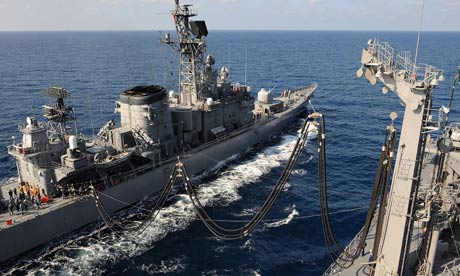
Japan-Maritime-Self-Defen-RAS

So the UK and Japan have a ‘new type of alliance‘, and it has a maritime focus. And a ‘hotline‘ to coordinate actions in an emergency.

So there is a disaster in the Philippines and both the UK and Japan are using their military in the Humanitarian Assistance & Disaster Relief role (HADR). Japan is sending its Self Defence Forces too.

So the UK Royal Navy is sending a helicopter ship to help, but their problem is getting replenished at sea (because the supply ships take too long to steam around the world, and can’t keep up with HMS Illustrious). But you can’t just expect anyone to do RAS – it is tricky and potentially dangerous, so it takes practice. Hmmm.

But wait, didn’t the RN and the MSDF cooperate in the Indian Ocean a little while ago, with Japan’s ships replenishing the RN and others with fuel, etc?

Mr. Abe, Mr. Cameron, what are you waiting for?

TOPSHOTS-PHILIPINES-WEATHER-TYPHOON

5 Comments

Filed under Uncategorized

UK & Japan National Security Councils to be linked by ‘hotline’

hotline

Japan to set up national security hotline with Britain

As this Asahi Shinbun article explains, when Japan’s NSC is set up in January 2014 it will be linked by hotline to its counterpart in London –

“to develop closer ties and information- and analyses-sharing during times of emergency”

Leave a comment

Filed under Uncategorized