Category Archives: Uncategorized

Japan’s Marine Corps / Royal Marines – Room for cooperation?

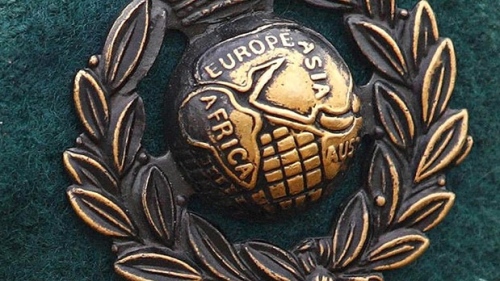
RM cap badgeThere have been stories around for a while about Japan’s plans to set up an amphibious infantry force – i.e. Marines. The general assumption is that this will be modeled on the US Marine Corps, as reflected in headlines like this:

Defense Ministry preparing Japanese version of U.S. Marines

Now I have a lot of time for the USMC, but wouldn’t the UK-Japan security relationship be missing a trick if it didn’t at least explore the potential rewards of  cooperation with the UK’s Royal Marine Commandos?

The naval flavour of defence cooperation remarked on in the recent RUSI conference would seem to offer a natural connection. Unlike the USMC, the RM are part of the Royal Navy. Indeed, as the Duke of York’s attendance at the RUSI conference  reminded some of us, the RN-RM combination has a respectable record on re-taking small islands.

And who else has ‘Asia’ on their cap badge?

5 Comments

Filed under Uncategorized

Japan and Great Britain: ‘A priori partners’

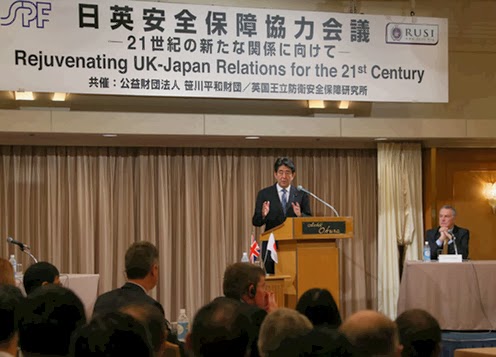
PM Shinzo Abe addressing the RUSI conference (source, RUSI)

PM Shinzo Abe addressing the RUSI conference (source, RUSI)

PM Shinzo Abe’s keynote speech at the RUSI conference on UK-Japan security (September 30 – October 1 2013) gave us a partial understanding of his plans for the UK-Japan relationship in the field of security (here in Japanese). Unfortunately I couldn’t be there, but I drew the following conclusions from reading the text  published afterwards:

1) Maritime security

Apparently this will be the focus of cooperation in the security relationship between the UK and Japan. This was a common denominator in all dimensions of the speech.

a) History:

“Japan learned the A to Z of modern navy entirely from the U.K”.

Cooperation in WWI was also referenced in terms of operations in the Mediterranean.

b) Symbolism: Prince Andrew (also in attendance) is an ex RN officer, well known for having taken part in operations in the Falklands War.

c) Strategy:

“great things are expected of the Japan-U.K. partnership also in the Northern Sea Route that is about to newly open up”

d) Law and order: UK-Japan cooperation on upholding the Law of the Seas seems to be the preferred framework for translating grand vision into practical action.

2) Light on specifics, heavy on ‘great expectations’

“Our two countries with such a history are poised to make a tremendous advance through our cooperative security relationship… this year may come to be appraised by our progeny and by historians as a year in which breakthroughs were achieved”.

Again, this point was substantiated with reference to the upcoming visit of the UK’s First Sea Lord and HMS Daring. Watch this space.

But what is this ‘a priory’ description about? In terms of philosophy ‘a priory’ refers to an argument that is self-evidently true, not requiring evidence to demonstrate its validity (e.g. all batchelors are unmarried).

Abe clarified what he meant by saying the relationship ‘evolved organically’, which I took to mean the UK and Japan had so much in common (Monarchy, island history, skill in balancing tradition and innovation) that it was somehow inevitable that they would become allies.

By comparison with Japan-US relations, the anchor of which is routinely ascribed to ‘shared values’ of democracy, rule of law and free trade –  is the implication that UK-Japan relations are based on something less technocratic, and more connected with culture and national psychology. More…organic. Personally I find this vaguely compelling. I can also see how Abe’s attitude to the present constitution of Japan (that it was a post-war ‘imposition’ by the US) reflects some ambivalence to ‘man-made’ – (contrasted with ‘organic’) framework of values.

3) It’s OK to mention the war.

The UK-Japan partnership allows Abe to highlight a relationship with a WWII enemy country that has healed well. This can also be said of the Japan-US partnership, and that with Australia and New Zealand, in contrast to that with China and Korea, among others. This may not be of much use in ameliorating the effects of ‘war memory’ in other bilateral relations, however. Paradoxically, the feelings between UK/Japan over WWII  have healed comparatively well because of the distance between their homelands – the distance that is the main obstacle to constructing meaningful relations today. The contest was over colonial claims and hardly touched respective home territory. Having said that, the occupation of Shanghai, Singapore and Malaya and related issues of POW treatment meant that our war experience was not purely of a military-to-military nature.

Is this perhaps an indication that ‘war memory’ is not quite the right term for this problem in Japan’s relations with its neighbors? When it comes to China and Korea, is the problem more about colonial memory than war memory? That remains a more difficult area of history for the UK as well. Then might there be scope for joint UK-Japan cooperation on healing the scars of colonial history?

4) Knowledge and wisdom as the currency of the security partnership.

This is a logical response to the limits distance imposes on how much the UK and Japan can do together in terms of physical security cooperation. The ‘networked world’ Abe referred to is presumably a reference to cooperation in the realm of cyber security and intelligence generally.

5) Relations with the USA

“Of course, the United States remains our ever-unchanging primary cooperation partner. This is certainly also true for the United Kingdom. On that basis, I would like to state my eagerness for Japan and the United Kingdom to exchange knowledge and share experiences with each other and walk forward together, as partners who jointly accept responsibility for world peace and stability.”

Interesting nuances here. These two sentences conjure up an image of the UK and Japan  sharing notes on how to handle its alliance relationship with the US. This is open to at least two interpretations – that lessons can be learned on how to make the relationship work, and that lessons on being a junior partner can be shared in order to make the alliance work better for Japan and the UK.

6) Economy

Abe ended the speech with a revealing coupling of how he sees the importance of economy and security –

“First of all, we will strengthen the economy. Nothing will get underway until we achieve that”

but

“The reason we will strengthen the economy is of course in order to leave to future generations a Japan that is secure and enjoys peace of mind. It is also because we strive to be a nation that is able to fulfil its duties to the world, in a manner appropriate for this banner of “proactively contributing to peace.””

What is the audience to conclude? That the economy comes first, but not because of a value judgment about its priority for the Japanese people, but because it is a prerequisite, or a means to an end of security and influence?

Conclusion

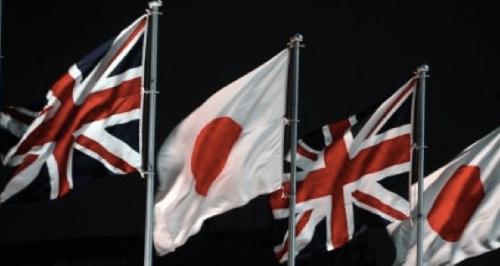
The speech identified the main areas of cooperation in the future: upholding or defending the rules governing maritime security, (including the high north), intelligence, US alliance management. The Japanese version of the theme for Abe’s speech was ‘towards a new 21st century relationship’ – not quite the same as ‘rejuvenating’ the relationship, and not quite as eyebrow-raising as ‘a new type of alliance‘. But in general, the speech raised expectations, promising great things to come. The question is now that PM Abe has articulated how he sees the relationship from Japan’s perspective – who will present the UK point of view?

3 Comments

Filed under Uncategorized

Rejuvenating UK-Japan Relations for the 21st Century

Screen Shot 2013-09-21 at 12.10.12 PM

RUSI has published further details on its conference on UK and Japan security cooperation (link).

The conference will review recent developments in security cooperation between Japan and the UK and seek to identify areas in which practical cooperation can be furthered.

The programme looks interesting.

It is almost exclusively a UK-Japan affair, but with one telling exception – Admiral Dennis Blair (Former US Director of National Intelligence) will be there to give a lecture entitled “East Asian Stability and the US-Japan-UK Alliance”. I look forward to hearing more about this.

Leave a comment

Filed under Uncategorized

UK-Japan Security Conference

There will be a conference on UK-Japan security on October (link) on 30 September and 1 October, attended by PM Abe and the Prince Andrew (Duke of York).

The event was advertised on the Japan 400 website.

In developing UK-Japan security cooperation, the Royal United Services Institute (RUSI), the world’s renowned and oldest defense and security think tank, will stage a special conference on “UK-Japan Security in 2013″ in Tokyo in this October . The RUSI delegation will be headed by His Royal Highness the Duke of York and former British ministerial members. Top-level politicians and leaders in defense field from Japan, UK and US will also attend the conference. Japan’s Prime Minister Shinzo Abe and Adm Dennis C. Blair, the US former Director National Intelligence, will make a special speech in our conference.

Final details to be confirmed.

Please see the RUSI website

Leave a comment

Filed under Uncategorized

The Anglo-Japan Alliance, then and now

Prime Ministers Cameron and Abe at 2013 G8 Summit
Prime Ministers Cameron and Abe at 2013 G8 Summit

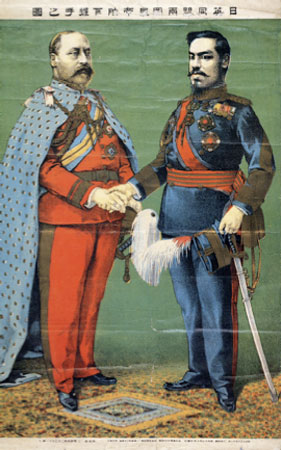
Emperors of the two countries of the Anglo-Japanese Alliance, 1905.

Emperors of the two countries of the Anglo-Japanese Alliance, 1905.

Is understanding  the 1902 alliance useful for thinking about contemporary relations between Britain and Japan? One might suppose that so much has changed in the last century as to leave only sentimental value in such a comparison. But you only know if you try…

What was the old alliance for, and why did it end?

  1. Russia: the original alliance was formed against Russia, and that threat had (particularly from the Anglo perspective) been addressed as early as 1907. Russia had fought on the same side as Britain and Japan in WWI.
  2. China: views on China had begun to diverge since before WWI (e.g. over the ‘open door’), and as Japan’s dominance was increased by the addition of former German possessions, Britain became increasingly reluctant to back Japan’s defence of its position in China against American pressure.
  3. America: Understanding of American strength reached through experience in WWI (as well as deep cultural affinities), convinced Britain that it would not fight America. After WWI, the only peer competitor that offered a rationale for the Royal Navy was Japan. Nationalism, Partly driven by US support for self-determination, was corroding the colonial form of empire in the 1920s. After WWII, America build a post-colonial form of Empire around the policy of containing the USSR, and a global network of alliances which structured the separation of Europe and Asia, and the UK and Japan.

What has changed?

So great are the changes over the past century that no-one would expect a return of the 1902 Anglo-Japan Alliance. The countries themselves have changed and so has the context in which they relate to one-another:

1. Britain and Japan: then they were not just nations but empires, whose dominance in their respective spheres of influence was an accepted feature of world order. Now they are upper-middle powered nation states allied to a superpower. There are no rivalries over imperial possessions in Asia, nor in their  ideologies and narratives about their role in the world. They share a parliamentary system of politics, monarchy, and mostly the same liberal social attitudes on individual liberty, market economics, etc. The issues of race that played a part in inter-war antipathy has diminished  almost to zero. A generational change has occurred in both countries, and those coming into adulthood and policy-making positions have no direct memory or attachment to the Imperial era or the WWII experience. As the UK Foreign Secretary said in one of his speeches describing the current government’s new approach to relations with Asia:

“Mine is the first generation in Britain that cannot remember the days of Empire, with the exception of the handover of Hong Kong which I attended. In all other respects, someone like me has no recollection of an earlier time, as I was a small child when countries like Malaysia and Singapore were gaining their independence. Today, our leaders and our people approach Asia in a wholly different spirit to the past – with a sense of equal partnership, respect and the desire to see opportunity and development for all”. (Hague, 2012 link)

2. World Order: WWII catalyzed the end of the colonial forms of empire that brought British and Japanese interests together in China, Korea and India. Instead we have state-directed commercial empires under the world order described in the UN Charter and a system of global economic governance (World Bank, IMF, G8, G20, etc). However, these structures of contemporary world order also offer incentives and channels for cooperation between allies.

3. Regional Integration – Then Britain was near its peak as a sovereign power. Now it is a part of a politico-economic union. Japan is not, but it conducts its diplomacy within a web of regional organizations (ARF, ASEAN+, EAS, etc.). These organizations may come to be regarded as the successor to older forms of empire.

4. America: The boot is truly on the other foot. Britain and Japan are both junior partners in their separate alliances with America. But America is in relative decline (marked by the sequester, the ‘leading from behind’ approach’, challenges by Russia and China, etc.), leading to wider questioning of its reliability as an ally. Is it time for Britain and Japan to ‘branch out‘ from their reliance on Uncle Sam?

5. China: The 1902 alliance was to some extent a product of the condition of China, which was a failing or collapsing state. The alliance was one way of addressing the risk of conflict between the great powers over the spoils of disorder in China and weakness in Korea. Now of course China is at the centre of interest in Asia, but for quite different reasons. The question then was how predatory powers organized their exploitation of China’s weakness. Now there is a common interest in how to maximize gains and reduce risks coming from China’s growing strength.

What has not changed?

1. Geography: Britain and Japan are still far apart, and so a new form of alliance will still be constructed from the things that lie between / connect them: Russia, America and the oceans.

2. Geo-politics: as in the second period of the early Alliance (after 1905), relations with America are still coming between the UK and Japan. In the later stages of the alliance (particularly after WWI), many in Britain saw in the Alliance dangers of entanglement. One was the risk of having to side with Japan’s more ambitious position on China. Another was the difficulty of taking a position in the event of war between Japan and America. Today fears of entanglement (in a war with China, North Korea or even Russia) would count among the factors against a revival of a formal alliance or common security agreement between Britain and Japan. However, if an anti-China axis forms including the UK’s most important ally (US) and Japan, this could reinforce the logic of UK aligning with Japan on China. There is competition among European powers for commercial advantage and influence in Asia, as before. Putin’s Russia is acting in a way that may stimulate Europeans and Asians to cooperate again in managing relations with the Bear.

3. Role in the world order: despite their diminished capacities, both the UK and Japan express a desire to influence the world outside. Japan talks of its ‘international contribution’, the UK of being ‘a force for good’. Of course both countries have vastly reduced military capacity compared to the earlier era, but they are serious players in proportion to their size and maintain high standards in military technology. The aerospace sector is a good example. The vast scale of America’s military distorts the global scale somewhat, but below that level there are still few other nations with the capacity for power projection like the UK and Japan.

What makes a new kind of alliance attractive?

1. Common world view –  British and Japanese leaders share some expectations about what a multi-polar world order means for their foreign policy:

We are living through a turbulent period in world affairs. Economic crises have put the global economy under strain and are accelerating the re-ordering of the political landscape. The emergence of new powers means that the international order is in flux, as it is in your region.  It is a more complicated international landscape with many more centres of decision-making than in the past, and our diplomacy needs to reflect that if we are to narrow these differences. Our world is not settling into blocs that require nations to choose between East and West or retreat behind ideological boundaries. There is far greater scope for flexible relationships that cut across geography, religion and political orientation, and this is a change that we embrace in Britain. (UK Foreign Minister William Hague, Fullerton Lecture, 2012)

In addition to strengthening Japan’s defence capabilities, the Abe administration also appears to be deliberately diversifying its security partnerships by branching out beyond the focus on its core alliance relationship with the United States, as well as by widening its security remit to include key energy security issues. (Swenson Wright, 2013 “Is Japan Truly ‘Back’? Prospects for a More Proactive Security Policy”)

2. World Order: The present world order (UN Security Council + free trade globalization) brings Anglo-Japanese interests together at the UN and through state-directed commerce. With Britain a permanent member of the UN Security Council and Japan a commercial superpower, the implications for shared interests are clear.

3. Regional integration – Britain’s membership of the EU makes it a useful channel to bring Japanese concerns to the table. Reciprocal advocacy may be enjoyed in a range of fora, such as ASEAN +, East Asia Forum, and NATO.

4. Alliances – Respective alliances with America are also a source of shared interest, the exploitation of which is a matter of the upmost delicacy. No doubt it helps when it comes to things like sharing intelligence and defence technology.

The question of what form the new type of alliance should take is one to which I will return in future blog postings. I welcome your comments.

Leave a comment

Filed under Uncategorized

“A new type of alliance”

His Excellency Mr Keiichi Hayashi shakes hands with William Hague (4 July 2013)

His Excellency Mr Keiichi Hayashi shakes hands with William Hague (4 July 2013)

The Ambassador of Japan to the UK, Keiichi Hayashi, gave a speech about Japan-UK relations on 23 July 2013 in Portsmouth, UK. One section of that speech sums up the current status and direction of Anglo-Japan relations on a strategic level:

“By mentioning the Anglo-Japanese Alliance, I am not seeking merely to dwell on past glories. Surely we had the tragedy of another war which we fought against each other and have always to squarely face. However, we are now nurturing a new partnership in the defence and security areas, which perhaps we can call a new type of alliance” (my emphasis).

The UK’s Foreign Minister William Hague also used the ‘A-word’ recently:

“Japan is a key ally of the UK and we work closely together on many issues of global foreign and security policy”.

What is going on? Of course Japan and Britain were allies about a century ago, but surely that era is so far behind us as to bear no relation to the present circumstances. Or is it?

“The focus of international competition is moving steadily towards the Pacific Ocean and… Japan is obliged… to play an ever increasingly [sic] part in the peaceful development of that portion of the globe [cheers]. I sincerely hope … that these friendly feelings and mutual sympathies which have existed between us in the past shall be daily more strongly cemented in the future [cheers].”  Ito Hirobumi, London, 3 January 1902

Might today’s ‘partnership’ be different in form, but similar to the old alliance in function? Given the changes that have occurred in Japan, Britain and the rest of the world since the early 1920s, difference in form is to be expected. Understanding those differences might even tell us something worthwhile about Japan and Britain’s place in the world today.

This ‘new type of alliance’ between the UK and Japan is the subject of this blog. Over coming months, I invite you to contribute to the search for answers to the following questions:

  • What is the evidence for  a new type of alliance developing between the UK and Japan?
  • What is this alliance for?
  • What  are the right standards and criteria for measuring the success of an Anglo-Japan alliance in the 21st Century?
Japanese Battleship Mikasa

Japanese Battleship Mikasa

6 Comments

Filed under Uncategorized